Malaysia's Economic Transformation Programme (ETP) Annual Report, 2012 was just recently released.
From the Report, Malaysia is expected to be on its way to achieve high-income status by 2020, if not earlier by 2018 if the current economic projections hold true when measured against the GDP growth and aligned with the implementations of the ETP Plan.
In terms of Gross National Income (GNI), Malaysia saw its GNI per capita increased to US$9,970 (RM30,239) as of end 2012 compared to US$6,700 (RM20,321) in 2009, a surge of 49% in the 3 years since the ETP was launched.
The ETP contains detailed Plan of Actions that encompasses 12 National Key Economic Areas (NKEAs) and 6 Strategic Reform Initiatives (SRIs) that aims to lift Malaysia into the high-income band by 2020 as defined by the World's Bank criterion of GNI US$15,000 per capita.
Projects (Entry Point Projects, EPPs) under the ETP gave the economy much needed boosts amidst a slow down in trade and the bleak global outlook with GDP up 5.1% in 2011 and 5.6% last year.
Robust domestic consumer demands, continued economic growth and investments, increase job creations and income growth contributed to the GDP registered.
Investment was at RM211.34 billion as at end 2012 which grew the GNI to RM135.64 billion, creating 408,443 jobs. The ETP as a whole envisions investments worth RM1.4 trillion and the creation of 3.3 million jobs in the 2011 to 2020 period.
According to the Performance Management and Delivery Unit (PEMANDU), the Country had surpassed its GNI and GDP targets for last year. Growth last year even outpaced Asia-Pacific's, which rose an average of 3.8%.
The Governor of the Malaysia Central Bank, Tan Sri Dr Zeti in an interview, in Kuala Lumpur, on 29th April, 2013 said that Malaysia is on track to achieve the GDP growth of 5-6% for 2013. The economy will continue to be driven by strong domestic demand and investments inflow. This is despite the current slow down in China and the challenges in the global economy in Europe, the US, the UK and Japan which are important trading partners to Malaysia.
Tan Sri Zeti said " ... these (global risks) are already priced into our forecast, but if it deteriorates further of course it will affect us".
Read more
In a management meeting, facts and figures on marketing performance for the previous month were presented. There were different views and feedbacks offered for the successes and failures for the month concerned.
Then you suddenly heard the boss said to someone ... "do not cherry pick"! You asked "what does cherry pick" mean?
If you had the opportunity of visiting a cherry farm during the harvesting season you will know what it means. You would pick the ripe cherries that you deemed tasty and ideal from the tree. You would ignore the other cherries though they may be just as good or they may not. Thus, "cherry picking" means selective picking of cherries of preference or choice. Thus, it is indeed a bias decision by the picker and to the picker's advantage and benefit.
Thus, in management jargon, it means that the person is bias and made decision which is to his own selfish advantage whilst ignoring those which are just as good if not better.
"Cherry picking" is normally used in the negative sense as a caution statement so that the person should be objective in decision making and in giving feedback and not bias or prejudice or ignoring other evidences that may help in better decision making or feedback.
Thus in making a decision or giving a view, it is important that a Manager considers all aspects of facts, circumstances and evidences before arriving to a conclusion. Thus, it must be an informed decision or view.
Read more
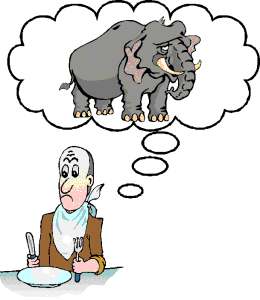
How to eat an elephant? An elephant is an enormous creature whether it is from the Africa or Asia continent. So, how do you eat one?
This question is always being thrown at Managers who are faced with an enormous and great challenge or goal. The answer is simple: One bite size at a time until all is consumed!
 In other words, cut or compartmentalise the ultimate final challenge or goal to a series of manageable sizes or a series of smaller goals leading to the end goal ie to finish eating the whole elephant! Have immediate short term then medium to long term goals. Finally, the elephant will be consumed within the defined time frame.
How do you begin? Initially, size up the elephant. Design a plan and time period to cut and cook the elephant. Ensure that the right skill workers and tools are used. Map out the storage and delivery of the "cut" elephant over a period of time. Have contingency plan to manage and mitigate risks for unforeseen situations like "electrical black-outs" etc Do not lose sight of the end point of "eating the whole elephant". Leverage with whatever you have to achieve your goal!
In management jargon, it means to have a SWOT analysis done, design a business plan, identify your short, medium to long term goals in order to achieve the final overall goal. Ensure that the various available resources and risk management are in place. Remain focus to achieve the overall goal and have corrective actions if there are any distractions that will deviate the final goal to be achieved.
In conclusion, "Rome was not built in a day" so does "eating an elephant"!
Read more
Is there such a thing as luck in business? There are many entrepreneurs or successful business men who believe so.
Indeed there are 2 schools of thoughts - either you believe in luck or you do not.
As for me, I do not believe in luck. If you believe in God, it is God who directs and gives you success or failures. Whichever it is, it is for the betterment of the individual for God knows what is the best for the individual.
However, on the aspect of individual responsibility in managing the business, to put it simply, it is important that the individual must have the relevant skills and knowledge in the business that he is competing in. He must also have the network, leverage and connectivity in the market place. He must also have adequate resources, whether financials or human capitals to help him to sustain the business. He must also have the relevant leadership, wisdom and vision of business leadership.
There is a saying by a successful corporate leader "the harder you work, the more luck you have". True? Indeed, it is "working smart and hard" and NOT "working smart and NOT hard".
The world is real. It is about ability, capability, connectivity, space creation and hard work. Practise good governance and transparencies. The success that comes without all these basic elements will not be sustainable. It is not deep rooted. When there is great thunderstorm or calamity it will be uprooted and blown away. Thus a deep rooted tree will only be sustainable irregardless of the economic, social or political climates.
Lastly, fear God and be righteous in business. God will prosper the individual or corporate accordingly.
Read more
If you are to meet an individual anywhere other than in the work environment, the individual is just another number or individual in the crowd. You do not give a second look or any consideration for the individual. The most likely thing to happen, in the best case scenario, is a smile and hello ... and then you walked away.
The individual does not represent any centre of authority, influence, power or of interest to you.
 However, if the same individual dons on a formal office attire or uniform in the work environment or "sits" on a particular chair of authority, there is a transformation! Whether he ranks high in the hierarchy or low, he receives respect as he represents authority, influence or power.
Thus, there is a saying which says "respect the uniform/chair and not the person". Thus, the moment the individual retires or resigned from his position, he is just another individual. He becomes "faceless".
Unless, he is of an exemplary character, he will quickly fade away or be neglected or loses the respect immediately once he is not in "uniform" or the "chair". This applies whether the individual belongs to the uniform group or in any government or private sector.
Thus the value of life is to be of good, helpful and of exemplary character and the respect will "stick" to the person for life whether he is out of work environment or retired! Genuine respect is to be earned!
Read more
Lately, I had the opportunity to meet a couple of successful Entrepreneurs and Managers who were filled with the passions and respective visions to grow their "empires/companies" aggressively. I could not understand that, despite their great visions, they are trapped in the past with the "old mindset" and unwittingly applying their skill and knowledge of the past in today's decision making hoping for "high performance results".
We are in the age of knowledge and information overload and plentiful in skill availability. It puzzles me that these Entrepreneurs and Managers are still in the "primitive" environment with old skill sets, knowledge and structures.
Can this mindset entrapment brings about improvement in result and intent? The answer is "yes it can". However, the speed and quality may be a challenge. Will the practitioner realised this? "No" as they had no defined benchmark or set KPIs to begin with or there may be reasons to compromise the outcomes by the Entrepreneurs and Managers themselves.
Many of these Companies, owned and/or managed by these Entrepreneurs or Managers, undeniably cannot be classified as failures as the shareholders are happy with the revenues and returns BUT if only they realised their entrapment, they could propel themselves a few notches up the Performance grid and drive the Companies to higher performances!
I am a great believer in Newton's Third Law of "Equal and Opposite Reaction" or in today's term "cause and effect" or in IT lingo "rubbish in, rubbish out" ...
For these Entrepreneurs and Managers, my advice is to have objective "Gap Analysis" within the respective Companies ... identify Strengths, Weaknesses, Opportunities, Threats (SWOT) and work on these with solutions, set challenging KPIs ... and if you need to ... seek help! Not any help BUT the right help!
So there is hope!
Read more
I was not feeling well since last Saturday and thank God I am now almost recovered ...
The throat was dry. Voice was coarse. Body a bit awkward ... temperature seemed to be above normal ... hmmm... getting sick I told my family members.
Usual advice ... drink more water, avoid "heaty" food ... well I did that ... but it was of little help and I needed to prepare for the next day Church service. Throughout the day, I drank herbal tea, seeking relief from "fisherman lozenges" and tablets of paracetamol to lower the body temperature and meanwhile depending on the body immune system to do its work in bringing the body back to optimal working condition. Meanwhile, prayers helped ... God heard ...
Praise God, I went through the next day, Sunday Church service with no problem until the afternoon when the ailment relapsed with affirmative symptoms.
I decided to seek help and I drove to the Pharmacy to purchase antibiotic for the throat infection that led to secondary complications. It is good that in Malaysia the retail shop is always accessible. I started the therapy that very day and today I am feeling much better and had been on my feet since the last 2 days.
Why do I decide to write about this? Well, I cannot help but to counsel that an ailing Company must seek help as well if the Company after some internal restructuring or re-engineering and is still not able to recover or performed to expectation or as desired within the expected time frame then it is crucial and timely to seek external expertise and resources as well.
Like my body, it would quickly turn around and so does the Company provided that the right medication or resources is rightly sourced.
Read more